
Succession planning is not only about who could step into a role tomorrow. It is about whether the organization is intentionally building readiness before a transition creates urgency.
When knowledge sits with only one person, organizations become more vulnerable than they realize. The goal is not to create a list of names. The goal is to understand where readiness exists and where it needs to be developed.
What looks like a future staffing issue may actually be a leadership continuity issue. Organizations need to know where critical knowledge sits, where capability is developing, and where risk may be growing.
Practical Insights
Pay attention when:
Key roles depend heavily on one person.
Future leaders are not being developed.
Institutional knowledge is undocumented.
Transitions would disrupt operations.
Business Impact
When this is not addressed, organizations may experience:
Leadership gaps
Disrupted operations
Lost institutional knowledge
Reactive decisions
This Month’s Leadership Tool
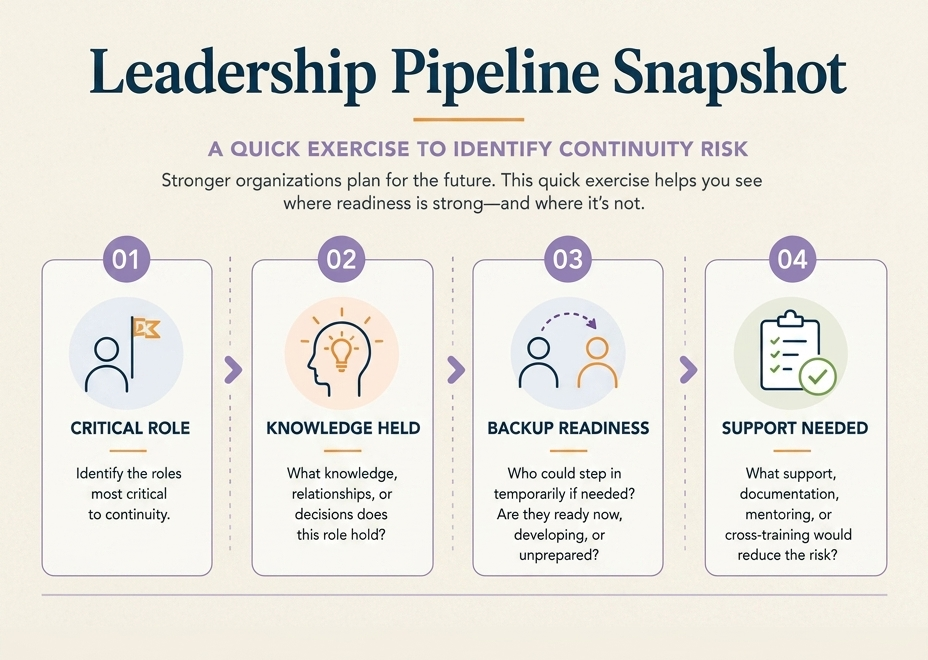
Leadership Pipeline Snapshot
This tool helps leaders identify where the organization may have future leadership risk.
How to guide the conversation:
List the roles that are most important to continuity.
Identify what knowledge, relationships, or decisions each role owns.
Name who could step in temporarily if needed.
Assess whether that person is ready now, ready soon, or still developing.
Identify what development, documentation, or cross-training is needed.
Choose one action to reduce leadership risk.
Use the snapshot to guide leadership development, knowledge transfer, and succession planning conversations.
Key Reflection Question:
Where would the organization be most vulnerable if a key leader transitioned tomorrow?
If key roles would be difficult to fill quickly, I can help you assess leadership readiness, identify continuity risks, and build a practical succession planning approach.
